Always the right cost
Alpha-TMS holds the full, accurate freight cost of each shipment, so you can match invoices yourself or remove invoice control altogether with self-billing.
The full cost, kept accurate
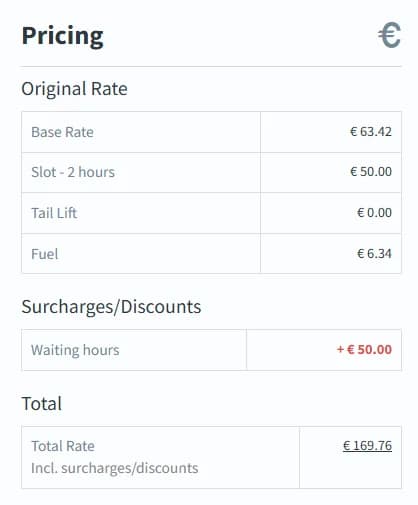
In alpha-TMS, rates are managed as a total cost, not just a base price. The cost of each shipment builds up in layers:
Base rate
Extra services
Fuel surcharge
Unforeseen costs
With every layer captured, alpha-TMS always holds the complete cost of each shipment. That accurate total is the basis for easy invoice control or self-billing.
Invoice control made easy
Because the total cost in alpha-TMS is always accurate, you have a reliable figure to check every carrier invoice against. There is no line-by-line reconciliation against rate sheets, since the agreed rate, services, fuel and any extra costs are already captured, so any difference between the invoice becomes visible. You can, of course, check manually or pass these costs straight to your own system. Through the alpha-TMS API, the accurate cost of each shipment flows into your ERP or finance system, so settlement continues in the tools you already use.

Self-billing
With self-billing, the carrier invoice disappears from the process altogether. Rather than receiving an invoice and checking it, you settle each order exactly as the costs are registered in alpha-TMS, and alpha-TMS issues the self-billing invoice to the carrier. There is nothing left for you to control; the carrier receives that invoice and checks it instead. These invoices can also be shared digitally with your own finance system.
Self-billing always needs to be agreed upon with the carrier first before you can activate it. You and the carrier settle on the same accurate cost, so freight payment becomes a by-product of execution rather than a separate process to manage.
Full cost transparency
Every cost is registered on the order: the base rate, extra services, fuel, tolls and surcharges, together with any unforeseen costs added afterwards by the carrier or client. Even fuel surcharges updated after an order is processed are reflected, so what you see is always the true, current cost of the shipment.
You can roll these costs up per carrier to see exactly where your freight spend goes, and because the breakdown is captured at order level, it feeds straight into your cost and performance analysis.
View analytics & performance
Key invoice control & self-billing functions
Total-cost rates
Every rate managed as a complete cost, not just a base price.
Layered costs
Base rate, extra services, fuel and unforeseen costs captured per order.
Retroactive fuel
Fuel surcharges updated even for orders already processed.
Unforeseen costs
Added by carriers or the client as they arise.
Invoice control
Check carrier invoices against the accurate cost held in alpha-TMS.
Finance-system integration
Costs and self-billing invoices shared with your system.
Self-billing
Settle orders directly and issue the self-billing invoice to the carrier.
Cost transparency
Full cost breakdown per shipment and per carrier.
Freight Settlement, Invoice Control & Self-Billing Software
Alpha-TMS gives shippers full control over freight settlement for outsourced transport. Every shipment cost is built up from the agreed rate, extra services, fuel surcharges and any unforeseen costs, so alpha-TMS always holds the complete, accurate cost of each shipment, even when fuel surcharges are updated after the order is processed. With that accurate total, shippers can check carrier invoices against agreed rates, share these costs to their ERP or finance system by API, or remove invoice checking entirely with self-billing, where alpha-TMS issues the invoice to the carrier directly. By linking execution to settlement, alpha-TMS replaces manual freight invoice checking with accurate cost control and automated freight payment across the whole carrier network.

Frequently asked questions
Everything you need to know about alpha-TMS
How does invoice control work in alpha-TMS?
Alpha-TMS captures the full cost of every shipment — base rate, extra services, fuel surcharge and any unforeseen costs — so you always have an accurate figure to check every carrier invoice against. No manual reconciliation against rate sheets is needed.
What is self-billing and how does it work?
With self-billing, you settle each order exactly as the costs are registered in alpha-TMS and alpha-TMS issues the self-billing invoice to the carrier. The carrier receives that invoice and checks it instead of sending you one. Self-billing must be agreed with the carrier first before it can be activated.
Can fuel surcharges be updated retroactively?
Yes. Fuel surcharges in alpha-TMS can be updated even for orders already processed, so the total cost of each shipment is always the true, current figure — not a snapshot from the time of booking.
Does alpha-TMS integrate with finance and ERP systems?
Yes. Through the alpha-TMS API, the accurate cost of each shipment flows into your ERP or finance system. Self-billing invoices can also be shared digitally with your own finance system.
Does alpha-TMS prefer certain carriers?
No. We are fully independent and have no agreements with carriers. This means we have no preference — the interest of our clients is always our top priority.
Can I see a full cost breakdown per carrier?
Yes. All costs are registered at order level and can be rolled up per carrier, giving you a full breakdown of where your freight spend goes. This data feeds directly into your cost and performance analysis.